

China Tour Package from India: What a 2026 Group Departure Actually Looks Like
September 22, 2026 | 10 Min. Read
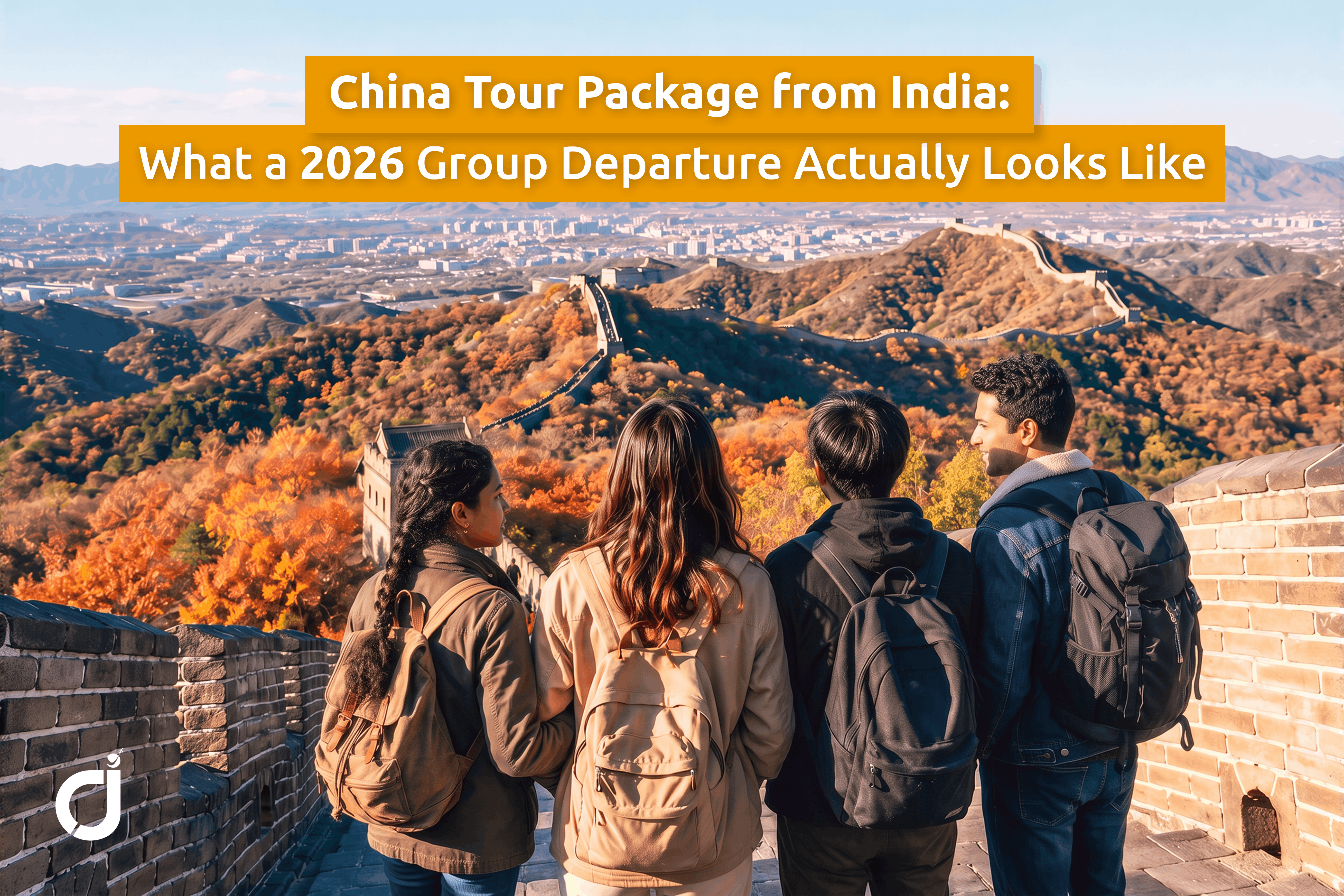
China has quietly become one of the most-requested destinations among Indian travellers — and not for the reason most people assume. It isn’t only about the Great Wall. It’s about a country where a 4,000-year-old temple sits three metro stops from a skyline that looks like it landed from 2050, and where a well-planned ten days can cover all of it comfortably.
If you have been looking at a China tour package from India, this guide covers what the trip involves, what it costs, how the visa works, and — the part most itineraries leave out — what it’s genuinely like to travel there as an Indian family.
Why China works so well as a group tour
China is the classic case of a destination that is spectacular to see and difficult to self-organise.
Signage outside major hotels is often Chinese-only. Google Maps, WhatsApp and Gmail don’t work without preparation. Domestic flight and bullet-train bookings sit on platforms that don’t accept most Indian cards. Restaurant menus assume you can read them.
None of that makes China hard to enjoy. It makes China hard to arrange. Which is exactly why an escorted group departure removes so much friction here compared to, say, Dubai or Singapore. Your transfers, tickets, entries and meals are already handled. You look at the country instead of at your phone.
The route that makes sense on a first visit
Most well-designed China itineraries build around three cities, connected by bullet train:
Beijing — the history. The Great Wall at Mutianyu, where the restored sections are walkable and the cable car spares your knees. The Forbidden City, Tiananmen Square, the Temple of Heaven, and a hutong walk through the old lanes that survived the rebuilding.
Xian — the one that surprises people. The Terracotta Warriors are extraordinary in a way photographs genuinely fail to convey — 8,000 individual faces, no two alike, standing exactly where a farmer digging a well found them in 1974. Xian also has the best-preserved city wall in China, cyclable at sunset, and a Muslim Quarter where the street food is largely vegetarian-friendly.
Shanghai — the future. The Bund at night, Yu Garden, the Shanghai Tower observation deck, and a river cruise that explains in ten minutes why this city became what it is.
Between them, the high-speed train — 300 km/h, spotless, and a far better experience than a domestic flight.
Where time allows, itineraries extend to Guilin and Yangshuo for the karst mountain landscape you see on the 20-yuan note, or Chengdu for the panda research base.
What a China tour package from India usually includes
A properly inclusive escorted package should cover:
Return international airfare from your departure city, usually via Kunming, Guangzhou or Singapore
Hotel accommodation, 4-star or above, centrally located
Daily breakfast plus most lunches and dinners — with Indian meal arrangements on the majority of days
All internal travel: bullet train tickets, private coaches, airport transfers
Entrance fees to every listed monument
An English-speaking local guide in each city
A tour manager travelling with the group from India
Visa processing assistance
Travel insurance
Read any quote carefully for what sits outside it. Entry tickets excluded from the headline price are the most common gap — and at Chinese monuments they add up quickly.
Indian food in China: the honest answer
This is the single most-asked question, so let’s be direct.
Indian restaurants exist in Beijing, Shanghai and Xian, and a good operator builds meals around them. On travel days and at remote sights, meals are Chinese — and a vegetarian traveller without arrangements can struggle, because “vegetable” dishes are frequently cooked in meat stock or shared oil.
The workable solution is the one experienced groups use: pre-arranged Indian meals on most days, a Jain or pure-veg brief passed to kitchens in advance, and a tour manager who carries the buffer of theplas, khakhras and ready-to-eat packs that make travel days painless. Ask any operator how they handle this before you book. The specificity of the answer tells you a great deal.
The China visa for Indian passport holders
Indians require a tourist visa (Category L) in advance. In practice it means:
Passport valid at least six months beyond travel, with two blank pages
Completed application with a recent photograph to Chinese specification
Confirmed flights and hotel bookings for the full stay
Financial documents, usually six months of bank statements
Biometrics in person at the designated visa application centre for your city
Processing typically runs four to seven working days once the file is complete, but requirements change, and they change without much notice. This is the strongest practical argument for booking through an operator who submits China files regularly rather than occasionally.
When to go
September to November is the best window overall — mild, dry, and Beijing’s autumn is genuinely beautiful. March to May is the second choice, with blossom in the north. December to February is cold in Beijing but the least crowded, and the Wall in light snow is unforgettable.
What to ask before you book
How large is the group? Anything above 30 slows every transfer and every entry queue.
Is there a tour manager travelling with you from India, or do you meet a guide on arrival?
Which meals are Indian, on which days?
Are monument entries included or paid locally?
What is the room category, and what happens if you’re travelling as a single or as three sharing?
What support exists if something goes wrong at 2am local time?
That last question matters more than the price difference between two quotes. Most trips run smoothly. The value of a good operator becomes visible on the day one doesn’t.