
Japan Tour Package from India: The Complete Guide to Getting It Right
October 2, 2026 | 10 Min. Read
Japan is the destination Indian travellers research the longest and book the latest. Everyone wants to go. Almost everyone assumes it’s more difficult and more expensive than it turns out to be.
It is neither, if the trip is planned properly. What Japan does demand is precision — this is a country that runs on schedules measured in seconds, where the difference between a good trip and a great one is knowing which train, which entrance, which day, which season.
Here’s what a Japan tour package from India should contain, and how to judge one.
The Route That Works on a First Trip
The core of any first Japan itinerary is the Golden Route, and it earns its name.
Tokyo — three nights. Senso-ji temple in Asakusa, the crossing at Shibuya, Meiji Shrine, the electronics and anime districts of Akihabara, and a day that most itineraries skip but shouldn’t: teamLab’s digital art museum, which even travellers who dislike museums remember for years.
Mount Fuji and Hakone — one night. The Fuji Five Lakes region, a ropeway, a lake cruise, and — if the weather cooperates — the mountain itself. Fuji is famously shy; roughly one visitor in three gets a clear view. Itineraries that build in a full day rather than a drive-past improve those odds considerably.
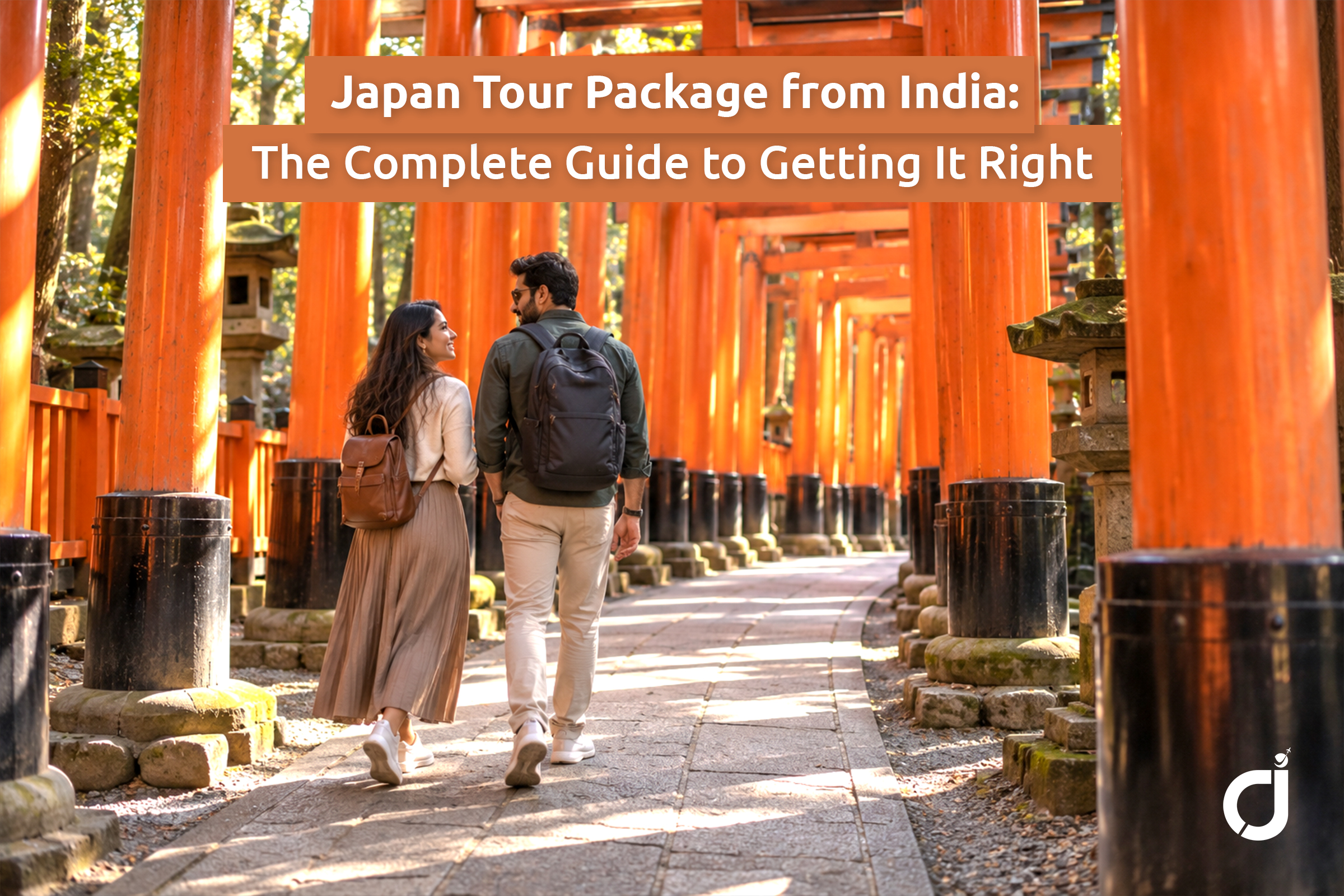
Kyoto — three nights. The single most rewarding city in Japan. Fushimi Inari’s thousand torii gates, the bamboo grove at Arashiyama, Kinkaku-ji’s golden pavilion, Gion’s wooden lanes where geiko still work. Kyoto rewards slowness, and any itinerary that gives it fewer than three nights is cutting the wrong corner.
Nara — a day trip. Free-roaming deer and Japan’s largest bronze Buddha.
Osaka — one or two nights. Dotonbori at night, castle by day, and the country’s most enjoyable food street culture.
Ten to eleven days covers this comfortably. Longer trips add Hiroshima and Miyajima, or Kanazawa and the Japanese Alps, or Nikko in autumn.
When to Go: This Matters More in Japan Than Almost Anywhere
Late March to early April — cherry blossom (sakura). The most beautiful and the most crowded. Dates shift year to year with the weather, so blossom trips carry inherent uncertainty and need booking six to nine months out. [See our separate guide to planning a Hanami trip.]
Late October to early December — autumn colour (koyo). In many ways the better choice. Cooler, drier, less crowded than sakura, and Kyoto’s maple gardens in late November are extraordinary. Comfortable 12–20°C weather suits Indian travellers well.
May and June are pleasant, with June bringing the rainy season in the south.
July and August are hot and humid — genuinely uncomfortable, and best avoided.
January and February are cold but clear, with the Sapporo snow festival and the least crowded temples of the year.
What a Good Japan Package Includes
- Return flights from your departure city
- Centrally located hotels — location matters disproportionately in Tokyo and Kyoto
- Japan Rail Pass or point-to-point bullet train tickets
- Daily breakfast, plus Indian meals on most days
- All entry fees to listed temples, shrines and observation decks
- English-speaking local guides
- A tour manager travelling with the group
- Visa processing
- Airport transfers and porterage
- Travel insurance
Two things to look for in the small print. First, hotel location — a “Tokyo hotel” in Chiba is technically accurate and practically a 50-minute commute from everything you came to see. Second, whether bullet train travel is included or optional. The Tokyo–Kyoto shinkansen is not a cheap add-on.
Indian and Vegetarian Food in Japan: The Real Picture
Japan is a difficult country for strict vegetarians and a genuinely hard one for Jain travellers if you arrive unprepared. Dashi — a stock made from bonito fish flakes — is in a great deal of food that appears vegetarian, including miso soup and many noodle broths. Onion and garlic are used freely.
What works:
Indian restaurants are plentiful, particularly in Tokyo, Kyoto and Osaka, and the quality is high — Japan has a substantial South Asian community.
Shojin ryori, Buddhist temple cuisine, is entirely plant-based and available in Kyoto. It is also one of the most memorable meals in Japan.
Convenience stores stock onigiri, fruit and packaged food that fills gaps on travel days.
A tour manager carrying Indian provisions removes the anxiety from long transit days.
Ask any operator exactly how many meals are Indian and where. In Japan, this single answer separates a comfortable trip from a stressful one.
The Japan Visa for Indians
Indian passport holders need a tourist visa in advance, applied through the authorised visa application centre. Requirements typically include:
- Passport valid six months beyond travel
- Application form and photograph to specification
- Confirmed flight and hotel bookings covering the entire stay
- Day-by-day itinerary
- Income tax returns and bank statements
- Employment or business proof
Processing generally runs four to eight working days once submitted, though the volume of applications rises sharply before blossom and autumn seasons. Japan’s documentation standards are exacting — a file assembled incorrectly gets returned, and in peak season the resubmission can cost you the departure.
What Japan Costs from India
For a 9 to 11 day escorted group departure with flights, good 3 or 4-star centrally located hotels, bullet trains, most meals, entries and guides, expect roughly ₹2.2–3.2 lakh per person, with blossom and autumn departures at the upper end.
Independent travel can be done for less, but it comes with a real trade-off: Japan’s transport and reservation systems are efficient and unforgiving, its language barrier is significant outside major hotels, and a mistimed train or a missed temple reservation costs both money and the day.
Five Things First-Time Visitors Always Underestimate
How much you’ll walk. Fifteen to twenty thousand steps a day is normal. Comfortable shoes are not optional.
How cash-dependent parts of Japan remain. Cards are widely accepted in cities, less so at temples, small restaurants and rural stops.
How quiet public spaces are. Phone calls on trains are not done. Groups learn this fast.
Shoe removal. Temples, some restaurants and all ryokan. Slip-ons save you fifty seconds, forty times.
How good the ordinary food is. A convenience-store coffee in Japan is better than most café coffee elsewhere.