
Know What Tomorrow Looks Like Before You Go to Sleep Tonight
October 8, 2026 | 10 Min. Read
Here is a small thing that ruins a large number of holidays.
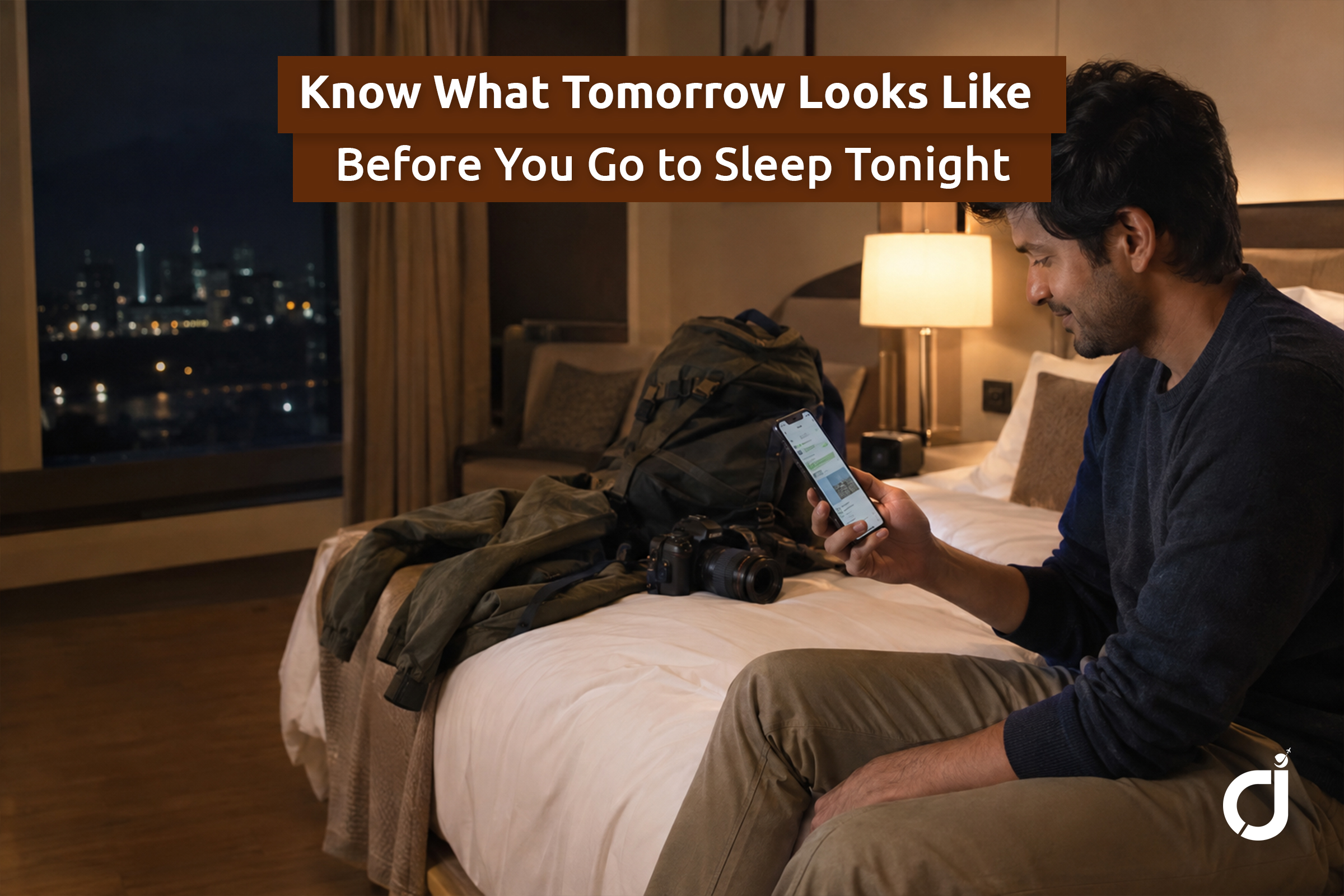
It’s 9pm. You’re in a hotel room in a city you don’t know. Tomorrow you’re going somewhere — you remember the name, roughly. You don’t know what time the bus leaves, whether it’ll be cold, how much walking is involved, whether there’s a dress code at the temple, whether lunch is included, or whether you should carry cash.
So you sleep badly, wake up unsure, and spend the first hour of a beautiful day mildly anxious about logistics instead of looking at where you are.
Multiply that by ten days. That’s the difference between a holiday you enjoyed and a holiday you survived.
The Fix Is Embarrassingly Simple
Every evening on a Joy-N-Crew tour, before you go to sleep, you receive tomorrow.
Not a vague outline. The actual day:
The itinerary — where you’re going, in what order, at what time
What to expect — how long at each stop, how much walking, whether there are stairs, whether there’s a queue
What to wear — the day’s weather, and any dress requirement at a religious or formal site
What to carry — cash, water, sunscreen, an extra layer, a scarf, comfortable shoes
Precautions — anything worth knowing, from pickpocket-prone streets to altitude to sun exposure
Important information — meal arrangements, departure times, your guide’s number, and where to find your tour manager
We call it Tour Shadowing. The traveller stops managing the trip and starts experiencing it.
Why This Matters More Than It Sounds
It removes decision fatigue. Holidays are exhausting partly because they’re a continuous stream of small decisions made without enough information. Shoes or sandals? Jacket or not? Big breakfast or light? Each one is trivial. Fifty a day is not.
It protects the people who need it most. A seventy-year-old parent who knows there are 120 steps at tomorrow’s temple can decide, calmly, the night before, that they’ll wait at the base and enjoy the courtyard. Told at the foot of the stairs with the group already climbing, the same person feels like a burden. The information isn’t logistics. It’s dignity.
It saves the day for families with children. Parents who know tomorrow involves four hours outdoors pack accordingly. Parents who find out at 9am improvise, and improvisation with children is expensive in both money and patience.
It makes the group work. Everyone arrives at the lobby ready at the same time, dressed appropriately, carrying what they need. Departures stop slipping by twenty minutes. And twenty minutes recovered every morning is nearly three hours of a ten-day holiday.
What It Looks Like in Practice
Kyoto, evening before day six.
Tomorrow: Fushimi Inari, Nara, and Gion in the evening. 7:30am breakfast, 8:15am departure. Fushimi Inari is a hill walk — the full loop is 2 hours and 4 kilometres, but the most photographed section is the first 20 minutes and that is where the group will turn back. Anyone who wants to continue, tell Ravi at breakfast.
Nara after lunch. The deer bow for biscuits and are entirely used to people, but hold your bags closed — they will investigate.
Evening in Gion. Cotton or light layers; 18°C, dry. Comfortable shoes today, not sandals — it is cobblestone and gravel.
Carry ¥3,000 in cash. The Nara biscuit stalls do not take cards. Lunch included. Dinner is Indian, 7:45pm, five minutes from the hotel.
That’s four minutes to read. It changes the entire quality of the following day.
Why Doesn’t Everyone Do This?
Because it’s work. It has to be written fresh for each group, each day, adjusted for the weather that’s actually forecast, the pace this particular group has settled into, and who in it needs what.
An operator running thirty coaches with a fixed printed itinerary cannot do it. An operator who thinks their job ends when the booking is confirmed won’t do it.
It only happens when someone decides that the traveller’s experience of the day is the product — not the coach seat, not the hotel room, not the entry ticket.
The Bigger Idea
Most travel companies sell you a destination. The destination isn’t the hard part — it was there before you booked and it’ll be there after.
What you’re actually buying is the difference between arriving somewhere confused and arriving somewhere ready. Between a family that spends the morning bickering about the plan and one that spends it looking at a shrine. Between a trip you remember for the temples and a trip you remember for the taxi you couldn’t find.
Tour Shadowing is one expression of that idea. Know what tomorrow looks like before you go to sleep tonight — and then simply enjoy it when it arrives.