
Kenya Safari Package from India: A Practical Planning Guide
October 14, 2026 | 10 Min. Read
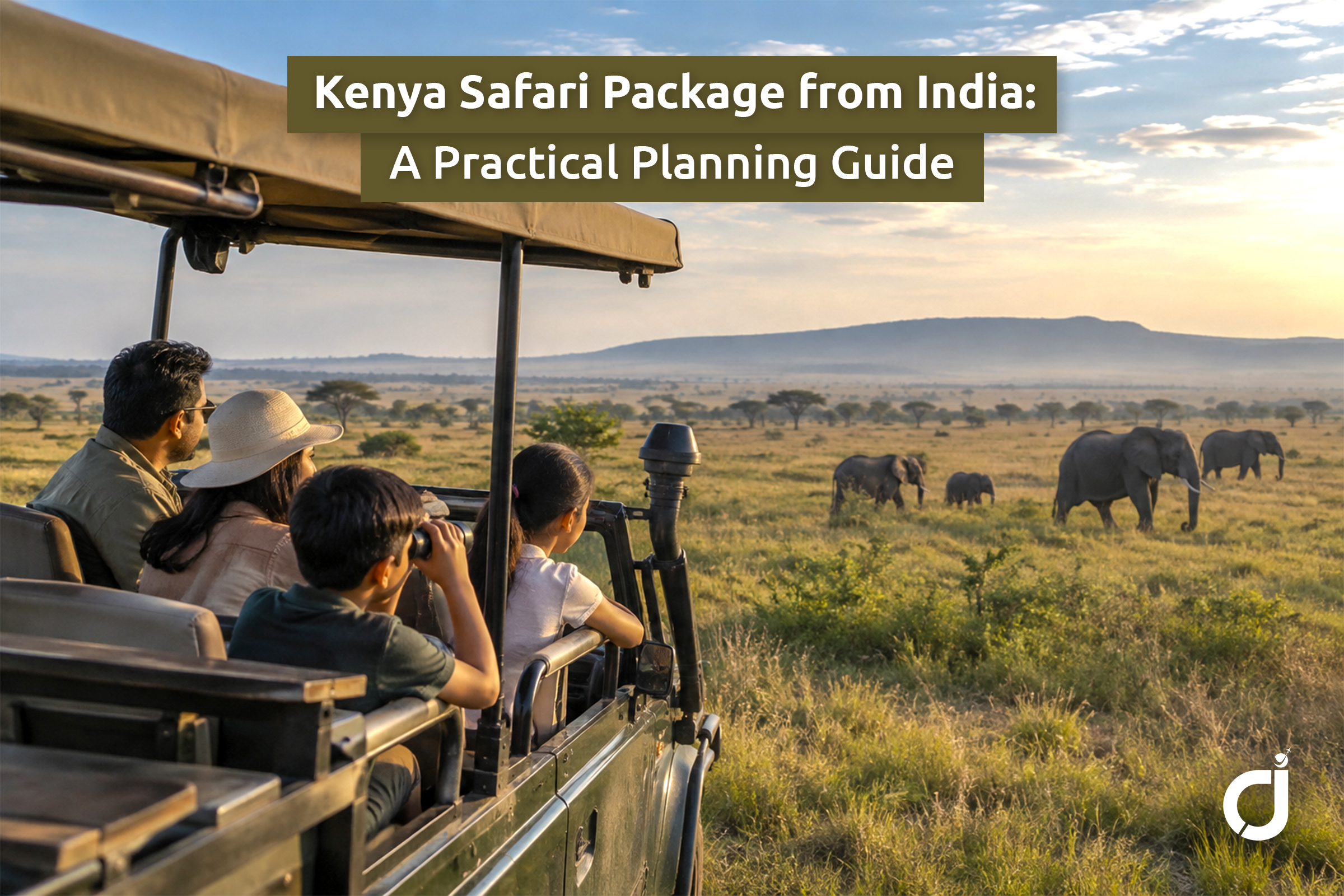
A safari is one of the few holidays where the thing you came for cannot be scheduled. You do not book a leopard. You put yourself in the right place, at the right time of year, with someone who knows the territory — and then the day gives you what it gives you.
Which is precisely why it’s the trip people remember longest.
Here’s what an Indian family should know before booking a Kenya safari package from India — when to go, what it costs, and the questions that actually determine whether the trip is good.
Why Kenya, specifically
East Africa has several excellent safari countries. Kenya’s advantages for Indian travellers are practical ones.
The flight is manageable. Direct and one-stop routings connect the major Indian metros to Nairobi in roughly six to nine hours, with a time difference of just two and a half hours. No jet lag worth mentioning.
The Masai Mara delivers. It is one of the highest-density wildlife areas on earth, and the reason first-time safari-goers see so much so quickly. Lion, elephant, buffalo, giraffe, zebra, wildebeest and cheetah are routine. Leopard and rhino are the ones that require luck.
Indian food is genuinely available. Nairobi has one of the largest Indian communities in Africa, with excellent restaurants, and safari lodges are well practised at Indian and vegetarian catering. Among long-haul destinations, Kenya is one of the easier ones for vegetarian and Jain travellers.
The infrastructure is set up for it. Lodges, camps, guides and internal flights are a mature industry here, not an improvisation.
When to go
July to October — the Great Migration. Roughly 1.5 million wildebeest and several hundred thousand zebra move from the Serengeti into the Masai Mara. The Mara River crossings — the ones you’ve seen filmed — typically occur between July and October, concentrated in August and September, though the animals keep their own calendar and nobody can promise a crossing on a given day.
October to November. The short rains arrive. Landscapes green up, birdlife is spectacular, crowds thin and prices soften. Excellent value, and this window lines up neatly with the Dussehra and Diwali break.
January to March. Dry, hot and excellent for game viewing as animals concentrate around water. February is calving season in the southern ecosystem, which brings predators.
April, May and early June. The long rains. Some camps close and roads become difficult. Cheapest, but not recommended for a first safari.
What a well-built Kenya itinerary looks like
Seven days is the practical minimum for a satisfying trip.
Nairobi, 1 night. Arrive, and if there’s time, the Giraffe Centre and the David Sheldrick elephant orphanage — both genuinely worthwhile, particularly with children.
Masai Mara, 3 nights. This is the heart of it. Three nights means six game drives, which is what it takes to move from “we saw animals” to “we watched a pride hunt at dawn”. Two nights is the most common mistake in Kenya itineraries.
Lake Nakuru or Lake Naivasha, 1–2 nights. Flamingos, rhino, and a boat safari at Naivasha for something different from a game drive.
Amboseli, 2 nights if time allows. Enormous elephant herds with Kilimanjaro behind them — the most photographed landscape in Kenya.
Internal flights between parks cost more than road transfers but save four to six hours each way. On a seven-day trip, flying the Mara leg is usually worth it.
What it costs
Kenya has a wide price band, and the variable is the accommodation.
For a 7-night itinerary from India with flights, mid-range lodges and tented camps, all game drives in a 4×4 with a pop-up roof, park fees, meals and transfers, expect roughly ₹2.2–3.2 lakh per person. Premium and luxury camps push this to ₹4–6 lakh or well beyond.
Two cost drivers to understand:
Park fees are substantial and non-negotiable. Masai Mara conservancy and reserve fees run to a meaningful daily amount per person and are set by the authorities. A quote that looks unusually cheap has often excluded them.
Vehicle sharing versus private. A shared game-drive vehicle is cheaper. A private vehicle means you decide when to leave, how long to stay with a sighting, and when to go back for the leopard at dusk. For families and for anyone serious about photography, private is the single best upgrade available.
The questions that determine trip quality
How many nights in the Mara? Three, ideally. Two is thin.
Is the vehicle private or shared?
Are game drives unlimited, or two per day? Full-day drives with a packed lunch reach parts of the reserve that morning-and-evening schedules never do.
Is the camp inside the reserve or outside the gate? Camps inside start their drive where the animals are. Camps outside spend the first hour driving to the gate.
Are park fees included?
What’s the guide’s experience? This matters more than the lodge. A good guide reads tracks, listens to alarm calls, and knows which pride has cubs. It is the difference between a game drive and a wildlife documentary.
With children and with parents
Children from about six upwards do very well. Game drives are long and bumpy, so the youngest travellers can struggle; many camps have minimum ages. Beyond that, the experience is unmatched — few things hold a ten-year-old’s attention like an elephant at fifteen feet.
Elderly travellers manage safaris comfortably. There’s little walking; the day is spent seated in a vehicle. The considerations are dust, rough roads, and early starts — 6am drives are when animals are active. Lodges with good ground-floor rooms and a slower two-drives-a-day rhythm work well.
Visa and health
Indian passport holders currently require an electronic travel authorisation obtained online before departure — straightforward, but not instant, so apply at least three weeks ahead and confirm the current requirement at the time of booking.
Yellow fever vaccination is required for travellers arriving from or transiting certain countries, and is advisable generally; the certificate becomes valid ten days after the shot. Malaria prophylaxis is recommended for the Mara. Speak to a travel clinic six weeks before departure.