

Your Family Doesn’t Travel the Same Way. One Itinerary Can Still Work.
October 20, 2026 | 5 Min. Read
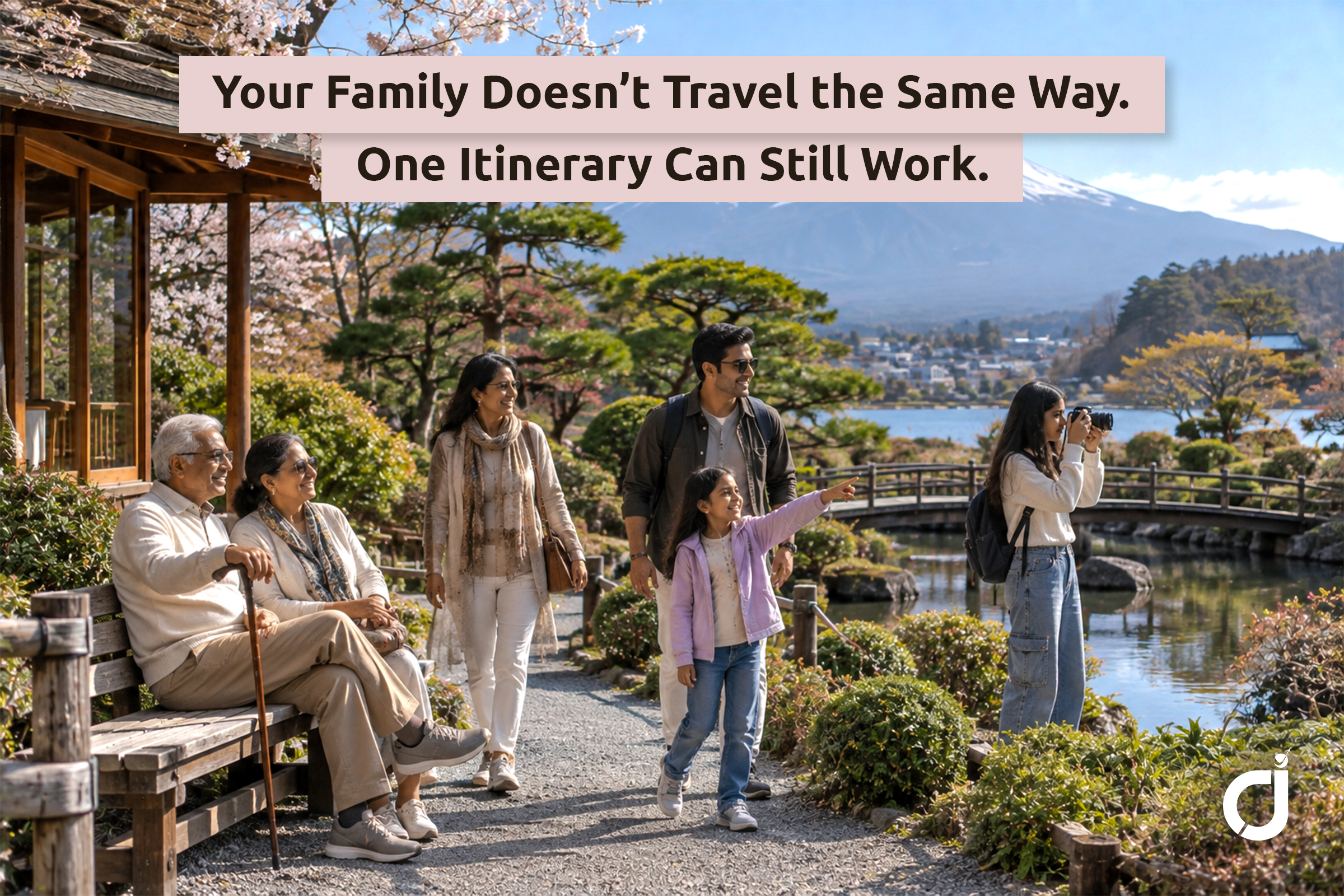
Picture the group. A nine-year-old who wants a theme park. A fourteen-year-old who wants Wi-Fi and to be left alone. Two parents who haven’t slept properly in a year and would quite like a beach. And a seventy-two-year-old who is fine walking, thank you, but who would rather not do four hours of it before lunch.
Most family holidays try to solve this by finding the average. Everybody gets something they half-wanted. Nobody gets what they came for.
The average is the wrong answer. Here’s the better one.
Rule one: build the day around the least mobile person
This sounds like a compromise. It isn’t. It’s the structural decision that makes everything else possible.
If the day’s pace suits the seventy-two-year-old, everyone else has energy in reserve. If the pace suits the forty-year-old, one person is exhausted and everyone else feels responsible for it — and a family that feels guilty is not a family on holiday.
Practically this means: one major activity in the morning, a real break in the middle of the day, one optional activity in the afternoon. Not three sights and a night market.
Rule two: split up on purpose
The single most under-used tool in family travel.
Not everyone has to do everything. A well-designed day has a fork in it: the teenagers and one parent go up the mountain, the grandparents and the youngest take the boat around the base, and everyone meets for dinner with something to talk about.
In practice this needs two things — a second guide or a pre-arranged transfer for the splinter group, and permission. Families often don’t split because it feels like a failure. It’s the opposite. It’s what allows a fourteen-year-old and a seventy-year-old to both enjoy the same holiday.
Rule three: give the teenager one thing that’s theirs
A fourteen-year-old on a family holiday is often a passenger in someone else’s plan, and behaves accordingly.
Hand them a decision. One activity in the trip that they choose and the family does. Or, better, one afternoon designed for them — surf lesson, street-food walk, the shopping district, a camera and a brief. The change in a teenager’s engagement across the rest of the trip is disproportionate to the effort.
Rule four: room configuration is a holiday-quality decision
More families’ holidays are affected by this than by the itinerary.
Three generations in adjoining rooms sounds efficient and often isn’t. Grandparents keep early hours; teenagers don’t. Young children nap in the afternoon and need a dark, quiet room, which means a parent is confined for two hours a day unless there’s an alternative space.
What works: connecting rooms rather than a single large one; an apartment or villa where there’s a common living space so nobody is trapped in a bedroom; and ground-floor or lift-adjacent rooms for the grandparents, always.
Rule five: food is not a detail
Three generations frequently eat three different ways. A grandparent may want simple vegetarian food at fixed hours. A child will eat six things, none of them new. An adult wants to try the place everyone’s talking about.
The trip that works has a reliable fallback near the hotel — somewhere that will serve dal, rice and roti at 7pm without a discussion — and adventure built in around it, not instead of it. Knowing there’s a safe option at the end of the day makes everyone more willing to try the unfamiliar one at lunch.
Destinations that make this easy
Singapore. Short flight, no jet lag, everything accessible, excellent Indian food, and genuine attractions for every age within a small radius.
Thailand. Beach base plus city, resorts with kids’ clubs, gentle temple visits, and short internal flights.
Bali. Villas with private pools solve the room problem and the “somewhere to be together without being on top of each other” problem simultaneously.
A cruise. Structurally the best answer to a wide age range. One unpacking, everything onboard, everyone finds their own rhythm, and the fork built into every day.
Japan and Europe work well too, but require more careful design — Japan involves significant walking, and European multi-city itineraries involve daily packing.
Destinations to think twice about
High altitude, long daily coach travel, itineraries with one-night hotel stays in five consecutive cities, and any trip where the highlight requires a strenuous hike. These aren’t impossible — they just need honest conversation before booking rather than discovery on day three.
What a good travel partner should be asking you
If you’re planning a family trip and the person arranging it hasn’t asked these, they’re selling you a package rather than designing a holiday:
Who exactly is travelling, and what are their ages?
Does anyone have mobility limitations, knee or hip issues, or difficulty with stairs and long standing?
Any medical conditions, medication schedules or dietary restrictions?
What does each person most want from this trip?
Is there anything you tried on a previous family trip that didn’t work?
How do the children handle early mornings and long travel days?
The answers change the itinerary substantially. Which is the entire point.
The idea underneath all of it
A family holiday isn’t one trip taken by five people. It’s five trips happening simultaneously, and the skill is designing an itinerary where all five can happen at once without anyone feeling like the compromise.
Different interests. Different energy. Different needs. One thoughtfully curated journey.