
Europe Tour Package from India: Why Late Autumn Beats Summer
October 26, 2026 | 10 Min. Read
Almost every Indian family travels to Europe between May and August. It is, on nearly every measure, the worst time to go.
Peak airfares. Peak hotel rates. Queues at the Vatican that begin before breakfast. Venice so crowded that the city has introduced entry restrictions. And a Schengen appointment backlog across Indian application centres that turns visa applications into a genuine gamble.
Travel between late September and early December instead and you get the same continent for materially less money, with a fraction of the crowds and cities that look their best in autumn light.
Here’s the case, and the one deadline that governs everything.
The visa timeline is the real constraint
Start here, because it determines whether the rest of this is relevant to you.
For Indian travellers, a Schengen application requires:
- An appointment slot at the visa application centre — availability fluctuates and is the genuine bottleneck
- Confirmed return flight bookings
- Confirmed hotel bookings for every night of the trip
- A day-by-day itinerary
- Travel insurance meeting Schengen minimum cover
- Six months of bank statements, income tax returns and employment proof
- Biometrics in person
Processing after submission is typically 15 calendar days and can extend to 45 in busy periods.
Working backwards, that means 8 to 10 weeks between deciding and departing. Not four. The families who miss Europe every year are not the ones who couldn’t afford it — they’re the ones who started in week six.
If Europe is on your list for this winter, the file needs to open now.
What autumn and early winter actually offer
Late September to October. Warm enough for outdoor dining, cool enough to walk all day. Autumn colour through Central Europe, Bavaria and the Alps. Summer crowds gone, prices down, and daylight still generous.
November. The quietest month in European tourism and the best value of the year. Museums, galleries and palaces without queues. Cool, sometimes grey — but a European city in November has a particular atmosphere that summer completely lacks. And from mid-month, the Christmas markets begin.
Early December. Christmas market season proper. Vienna, Prague, Budapest, Munich, Strasbourg and Cologne turn their central squares into wooden stalls with mulled wine, roasted chestnuts, handmade ornaments and lights. For Indian families this is genuinely one of the great European experiences and almost nobody from India plans around it.
Where to go in this window
Central Europe — Prague, Vienna, Budapest. The best autumn-winter combination available. Three magnificent cities close together, connected by short train journeys, with thermal baths in Budapest that are extraordinary in cold weather and the finest Christmas markets in Europe.
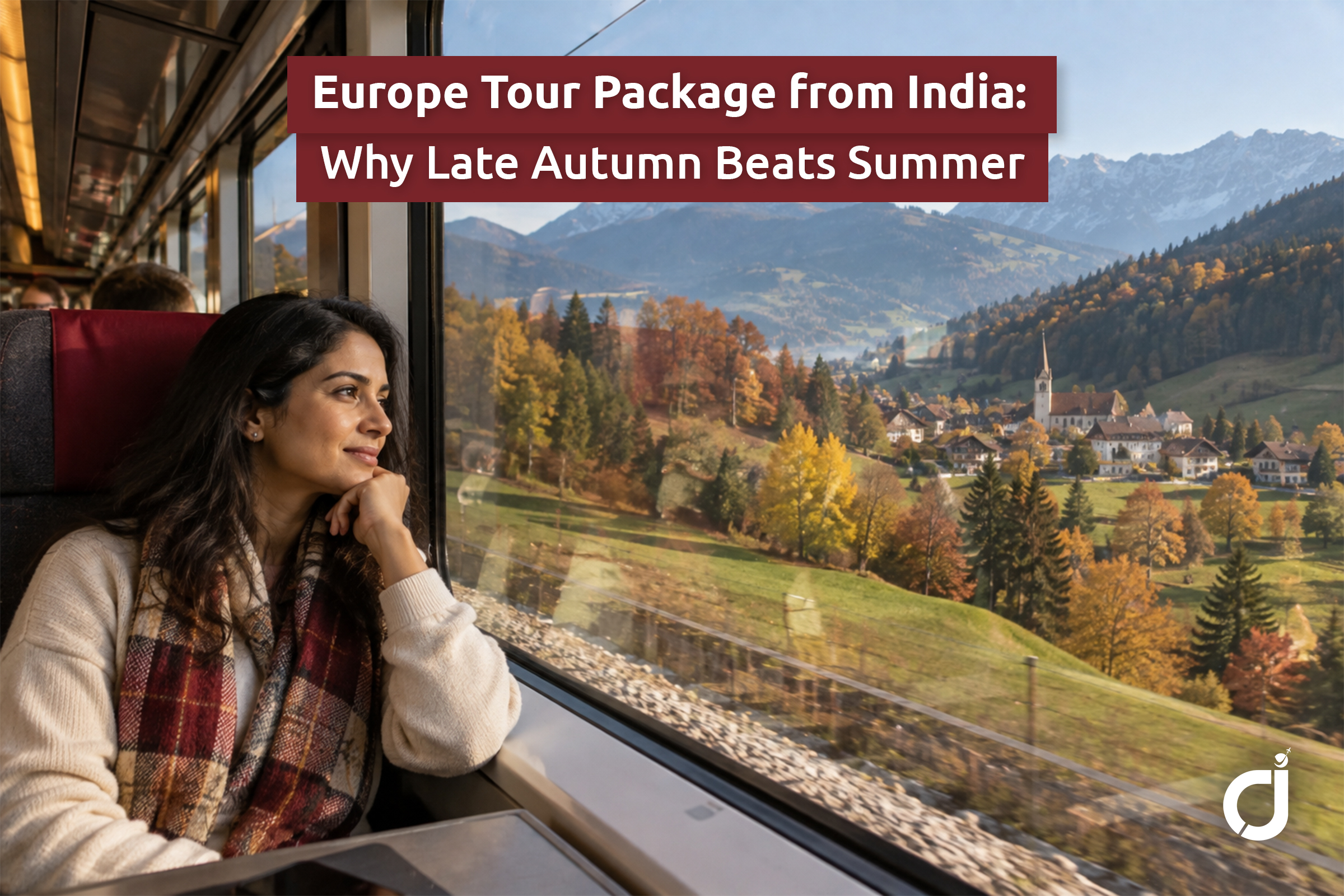
Switzerland and Austria. Autumn in the Alps is spectacular and far cheaper than the ski season. The scenic trains — Glacier Express, Bernina — run through valleys in full colour.
Italy. Rome, Florence and Venice in November are a different city from the same places in July. You can actually see the art.
Paris and the Netherlands. Paris in autumn needs no defence. Amsterdam in December is calm, lit and lovely.
Spain and Portugal. The mildest option, with daytime temperatures still comfortable through November and Andalusia at its best.
What it costs
For a 9 to 12 day escorted Europe tour from India covering three or four countries with flights, 4-star hotels, breakfasts, most dinners, coach transport, entries and guides, expect roughly ₹1.9–3 lakh per person in the autumn-winter window — meaningfully below summer pricing for the same itinerary.
Where the money goes matters more than the total. Two questions determine the quality of a European tour:
How many nights per hotel? An itinerary with five one-night stays means five mornings of packing, five check-ins and a great deal of your holiday spent in a coach. Two-night minimums transform the experience.
Are the headline entries included? The Vatican Museums, the Eiffel Tower summit, Sagrada Familia, the Anne Frank House, Neuschwanstein — these carry significant fees and timed-entry requirements, and they are the most commonly excluded items in a cheap-looking quote.
Practical notes for Indian travellers
Vegetarian food is easier in Europe than it was ten years ago. Italy is straightforward. Central Europe is meat-heavy but every city has Indian restaurants — Prague, Vienna and Budapest all have good ones. A tour with Indian dinners arranged on most days removes the issue entirely.
Weather. November in Central Europe means 2–10°C. That’s a warm coat, layers, gloves and waterproof shoes — not extreme, but not something to underestimate if you’re arriving from an Indian summer climate.
Daylight. Sunset arrives by 4:30pm in late November. It means earlier starts and a more compact sightseeing day, which good itineraries plan for and bad ones don’t.
Trains over coaches wherever possible. European rail is fast, comfortable and scenic, and it turns a transfer day into part of the trip.
The one-sentence version
Europe in November costs less, feels better and photographs beautifully — and the only thing standing between you and it is a visa file that needs to open ten weeks before you fly.