
Japan Cherry Blossom Tour 2027: Why You Need to Decide Now
October 29, 2026 | 10 Min. Read
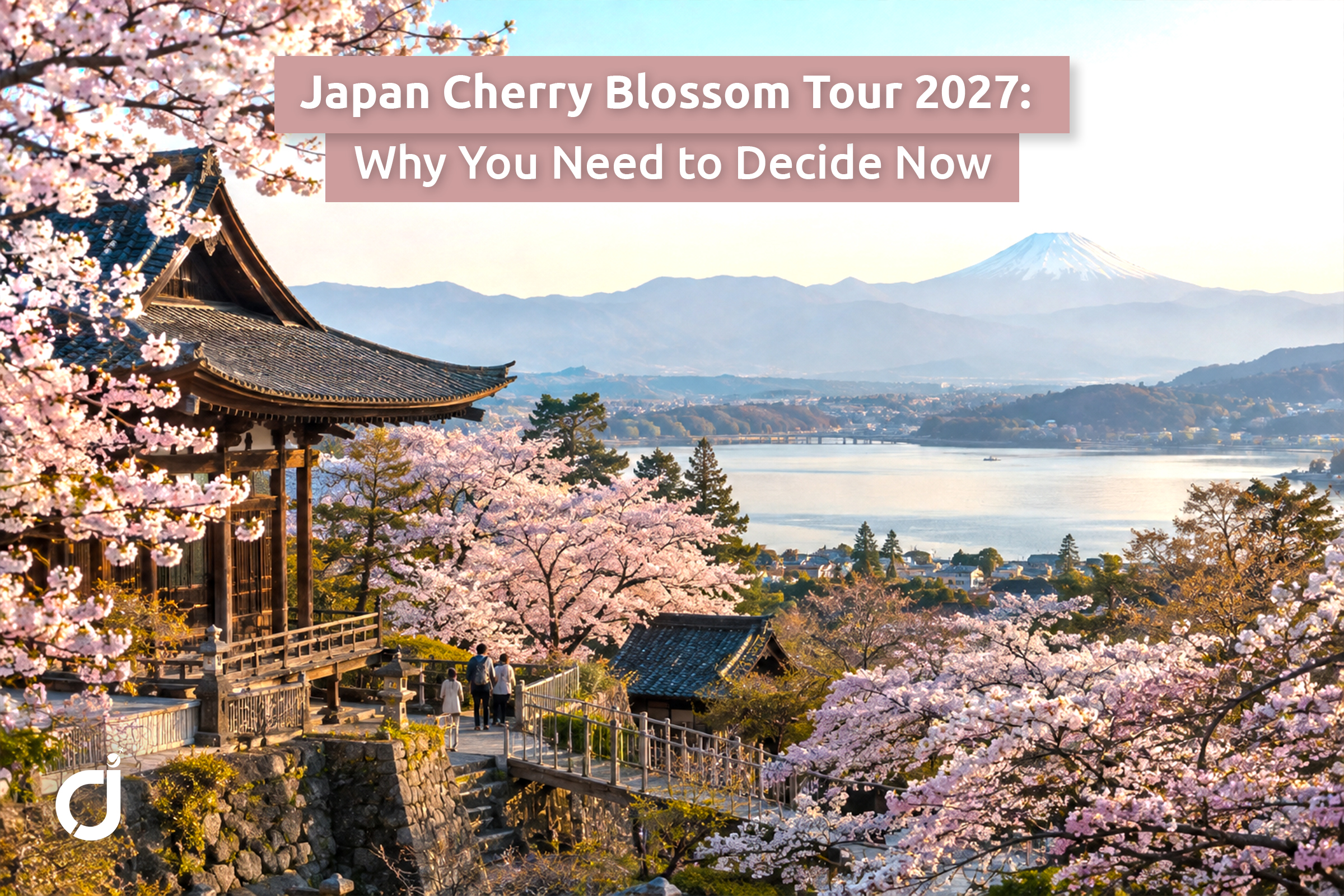
Cherry blossom season lasts about a week in any given city. Not a month, not a fortnight — roughly seven days from first bloom to peak, and another few days before wind and rain take the petals.
Hotels in Kyoto and Tokyo for those dates sell out six to nine months ahead. Flights from India rise steadily from about five months out. And the exact dates are not announced until roughly a month before, because they depend on the winter that precedes them.
So planning a Japan cherry blossom tour in 2027 requires booking before anyone knows the dates. Here’s how to do that intelligently rather than hopefully.
When sakura season happens
Blossom moves northward across Japan as spring advances — the “cherry blossom front”.
| Region | Typical peak bloom |
|---|---|
| Fukuoka, Hiroshima | Late March |
| Kyoto, Osaka, Nara | Late March to early April |
| Tokyo, Mount Fuji area | Late March to early April |
| Kanazawa, Japanese Alps | Early to mid-April |
| Sendai, Tohoku | Mid to late April |
| Sapporo, Hokkaido | Late April to early May |
Peak varies by up to two weeks year to year with winter temperatures. Japan’s meteorological services publish forecasts from January onwards, refined through February and March.
The practical planning window for the Golden Route — Tokyo, Fuji, Kyoto, Osaka — is 25 March to 8 April. A trip inside that window has a strong probability of blossom somewhere on the itinerary.
The strategy that actually protects you
Since you cannot know the dates when you book, you build an itinerary that’s resilient to them.
Cover an altitude and latitude spread. Blossom arrives in Tokyo before the Fuji lakes, and in central Kyoto before the mountain temples above it. An itinerary that includes both low and high ground in each region gives you two chances at the same location.
Include a north-south spread. Kyoto and Tokyo bloom at slightly different times most years. A route covering both increases your odds considerably over a single-city trip.
Travel in the wider window, not the exact predicted peak. Blossom before full bloom is delicate and beautiful. Blossom after peak brings hanafubuki — the petal blizzard, when the wind lifts thousands of petals off the trees at once. Many travellers find it the most memorable moment of the trip. Only a very narrow definition of success requires exact peak.
Book flexible where possible, and use an operator who monitors the forecast and can adjust the order of the itinerary in March.
What Hanami actually is
Hanami means “flower viewing”, and it is not a photo opportunity. It’s a national habit stretching back over a thousand years — families, colleagues and friends sitting under the trees with food and drink, for hours, doing nothing but being there.
The cultural idea beneath it is mono no aware: the poignancy of things precisely because they don’t last. The blossom is treasured because it falls. Understanding this changes what you’re looking at.
Join in. Buy a bento, find a spot in Maruyama Park or Ueno, and sit. It’s the most Japanese thing you can do in Japan.
Where to see it
Kyoto — the Philosopher’s Path along its canal, Maruyama Park, Kiyomizu-dera above the city, and the Arashiyama riverbank.
Tokyo — Ueno Park, Shinjuku Gyoen, Chidorigafuchi where you can row a boat beneath the branches, and Meguro River after dark, lit from the banks.
Mount Fuji — the Chureito Pagoda, which gives you pagoda, blossom and Fuji in a single frame. The most photographed view in Japan, and it earns it.
Nara — deer among blossom at Nara Park.
Himeji — the white castle surrounded by 1,000 trees.
Yozakura — night blossom viewing under illumination — is the version most itineraries skip and shouldn’t. Kyoto’s temple illuminations during sakura are extraordinary.
What it costs, and why
A blossom-season Japan tour costs more than the same itinerary in October. Hotel rates in Kyoto and Tokyo rise sharply for those two weeks, flights are at annual peak, and availability constrains everything.
For a 9 to 11 day escorted departure with flights from India, centrally located hotels, bullet trains, most meals and entries, expect roughly ₹2.6–3.6 lakh per person in sakura season.
The hotel component is where the increase concentrates, and it’s also where the compromises usually get made. A “Kyoto” hotel that’s 40 minutes from the centre is a poor trade during blossom season, when the whole point is being able to walk out at 7am before the crowds arrive.
The booking timeline
Now to December 2026 — decide, and reserve. Best hotel and flight availability.
January 2027 — first blossom forecasts published. Itinerary sequencing refined.
February 2027 — visa file assembled and submitted.
March 2027 — forecast updates; final adjustments to the daily order.
Late March 2027 — travel.
Families who begin this in February are choosing from what’s left, and paying a premium for it.