
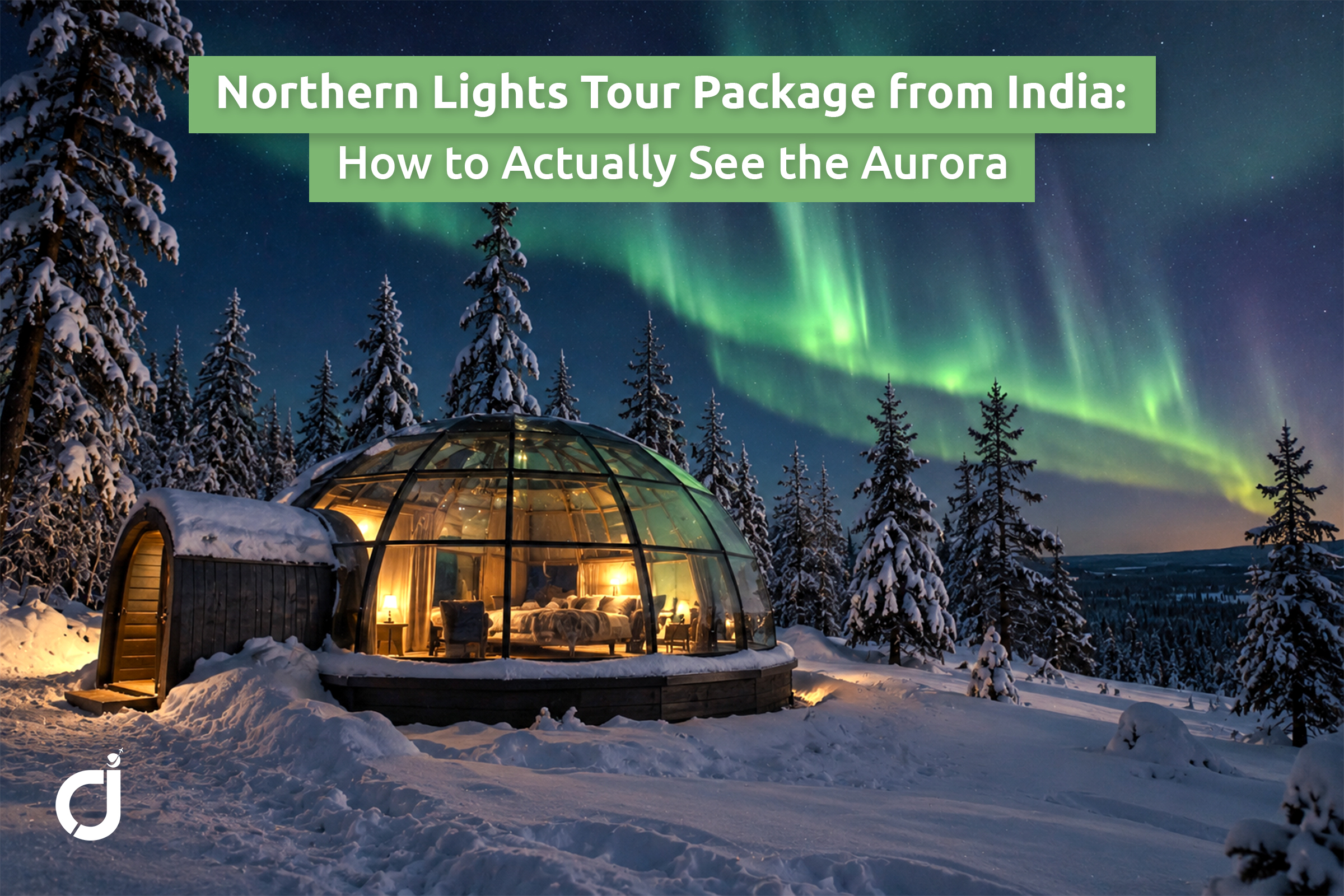
Northern Lights Tour Package from India: How to Actually See the Aurora
October 5, 2026 | 5 Min. Read
Most people who travel to see the Northern Lights and come home disappointed made the same mistake. They booked three nights.
The aurora is a weather event layered on top of a solar event. Both have to cooperate. Give yourself three nights in one location and you’re rolling a dice. Give yourself five or six nights across two locations, and the odds move decisively in your favour.
That single decision matters more than which country you choose, which hotel you book, or how much you spend. Here’s the rest of what you need to know before booking a Northern Lights tour package from India.
When the Aurora Is Visible
The season runs from late September to late March, and within it:
Late September to October — the “shoulder” season. Skies are dark enough, temperatures are milder, and lakes haven’t frozen, which gives you reflections in the water. Fewer snow activities available.
December to February — the coldest and darkest, with the longest aurora windows and the full winter experience: husky sledding, reindeer, snowmobiles, ice hotels. Temperatures can reach −25°C.
March — arguably the sweet spot. Statistically strong aurora activity around the equinox, snow still on the ground, and noticeably longer, warmer days for daytime activities.
You need darkness and clear skies. Full-moon periods wash out weaker displays, so the darker phases of the lunar cycle are marginally better — a detail good operators build into departure dates.
Where to Go
Finnish Lapland — Rovaniemi, Saariselkä, Levi. The most comfortable option and generally the best for families. Glass igloos, Santa Claus Village, excellent husky and reindeer operations, and a genuinely well-organised tourism infrastructure. Inland, so cloud cover is less frequent than on the coast.
Norway — Tromsø and the Lofoten Islands. The most dramatic scenery — fjords, mountains and sea under the aurora. Coastal weather means more cloud, but the Gulf Stream keeps temperatures milder than Lapland. Tromsø has genuine city amenities.
Iceland — Reykjavik and the south coast. Best if you want the aurora plus waterfalls, glaciers, black-sand beaches and the Blue Lagoon. Iceland’s weather is the most changeable of the three, so aurora success rates are slightly lower, but the daytime landscape is unmatched.
Sweden — Abisko. A specialist’s choice. Abisko sits in a rain shadow that produces the clearest skies in the region, and the Aurora Sky Station is one of the most reliable viewing points anywhere. Less to do in daylight.
The strongest itineraries combine two — typically Finland with Norway, or Iceland with a Lapland extension — precisely because it doubles your weather chances.
Being Honest About the Odds
No operator can guarantee the aurora. Anyone who does is selling you something they don’t control.
What a good operator can do is stack the odds: choose locations with historically favourable cloud cover, build in five or more aurora nights, use guides who monitor forecast data and drive to clearer skies rather than waiting at the hotel, and schedule departures around the darker phases of the moon.
With five to six nights in a well-chosen location, a strong majority of travellers see the aurora at least once. With three nights, it becomes a genuine gamble.
One more honest note: the aurora rarely looks to the naked eye the way it looks in photographs. Cameras gather light over several seconds and saturate colour. A moderate display often appears to the eye as a pale grey-green ribbon that moves. It is still remarkable — but travellers who expect the postcard on night one sometimes miss the beauty of what they’re actually watching.
The Cold, and How to Handle It
This is the second-biggest worry for Indian travellers, and it’s a solved problem.
Temperatures range from −5°C to −25°C. That sounds severe and is entirely manageable, because Arctic cold is dry rather than damp, and because the clothing system works:
Base layer: thermal top and bottoms, merino or synthetic — never cotton
Mid layer: fleece or wool
Outer layer: insulated, windproof and waterproof
Extremities: insulated boots, thick socks, gloves plus liner gloves, a wool hat and a neck gaiter
Almost every Arctic tour provides heavy thermal overalls and boots for outdoor activities and aurora hunts, so you don’t need to buy the most expensive items. Confirm this before shopping. Hand warmers are cheap and transformative.
Travellers over sixty manage this comfortably. What they need is sensible pacing — daytime activities that finish before dark, and warm indoor breaks built into the aurora evenings rather than four hours standing in a field.
What Else You Do All Day
The aurora is a night activity. The days are the other half of the trip, and in Lapland they’re superb:
- Husky sledding, which you drive yourself
- Reindeer sleigh rides with Sámi families
- Snowmobile safaris
- Ice fishing
- Snowshoe walks through boreal forest
- A night in a glass igloo, watching for the aurora from bed
- Santa Claus Village at Rovaniemi, on the Arctic Circle, which even sceptical adults enjoy
What It Costs from India
For a 7 to 9 day escorted departure with flights from India, hotels including at least one glass igloo or aurora cabin night, thermal gear, daily activities, most meals and multiple aurora hunts, expect roughly ₹2.8–4.5 lakh per person. Iceland typically sits at the higher end; Finnish Lapland offers the best value for the experiences included.
Most of these destinations require a Schengen visa, which needs eight to ten weeks of lead time in the winter application season. Norway, Finland, Sweden and Iceland are all Schengen members.
The One-Line Summary
Go for five nights or more, go to Lapland or Tromsø, go in December or March, dress in three layers, and don’t judge the display by what your camera shows you.
Frequently Asked Questions
What is the best month to see the Northern Lights?
December to February offers the longest hours of darkness, while March combines strong activity around the equinox with milder weather and longer days. Both are excellent; March is easier for travellers who are uncertain about extreme cold.
How many nights do I need to see the Northern Lights?
At least five. The aurora depends on both solar activity and clear skies, so more nights meaningfully improve your chances. Three-night trips are a gamble.
How much does a Northern Lights tour from India cost?
A 7–9 day escorted trip including flights, hotels, thermal clothing, daily winter activities and multiple aurora hunts generally costs ₹2.8–4.5 lakh per person, depending on country and hotel category.
Is a Northern Lights trip suitable for elderly travellers or children?
Yes, with the right pacing. Thermal gear is provided, activities can be selected by ability, and Finnish Lapland in particular is set up for families with children as well as older travellers.
Do Indians need a visa for a Northern Lights trip?
Yes. Finland, Norway, Sweden and Iceland are all Schengen countries, requiring a Schengen visa applied for well in advance — eight to ten weeks is a safe assumption during the winter season.